Monday, February 27, 2006

Spiritual Maturity


"Faith begins at a point where there is seemingly nothing to get out of it; nor is there any indication that prosperity will follow. Faith begins with a considerable doubt about one's own goodness and power".(Bishop Fulton sheen)

When times are good, its easy to love God, everything is coasting along nicely, and one considers oneself to have great faith. We live in expectation of a good God to provide everything we ask for, but at times God doesn't always give us what we ask for but what we need. And in our busy hectic world, where at times we have placed God in second place, in order to 'get ahead' or 'achieve our goals', then God may step in and cause us to re-think our priorities. At these times, when 'calamities' strike us or 'difficulties arise', our immediate reaction is to panic, then perhaps to apportion blame. When in fact God is merely helping us to set our hearts and minds on Him and Him alone!

So many times, maybe without realising it, we may be esteeming the opinion of others and relying solely on their opinion to gain a sense of self. Sometimes God will 'shake up' our 'safety zone', and what we have leaned on will no longer be there, because our Heavenly Father knows, we are building our faith on shifting sands, instead of placing our faith in the solid foundation of His Love and then to trust in His Love. And when this happens it is a very painful time, and our spirits can feel crushed, and we wonder 'where are you God'? 'Why is this happening'? And during this painful time, what we will receive from God is silence.

Why is God silent? Because He wants us to trust in Him, without the benefit of 'special feelings', our Heavenly Father is drawing us away from relying on feelings and relying on others, and instead to rely on Him alone. As Bishop Fulton Sheen says to paraphrase; 'real faith is expecting nothing, and then gaining everything!'As St Therese of Lisieux described her relationship to Jesus, she is like a ball in Jesus hands, He chooses when he wishes to 'play with this ball' and He chooses when to 'put aside this ball'.St Therese realised to never rely on 'feelings' but instead to love even unto folly (when it feels as if God has deserted us). As Jesus did us, to love us even unto death on a Cross.

What does God want us to do? To trust Him, not blindly but to trust Him knowing that He has only the best waiting for us. It would be so nice if at times we could just 'peek around the corner' & see what life may have in store for us, but that's not what trust is about. Its walking into the unknown, with courage and knowing that nothing will happen to us which God has not allowed, yes at times even harsh lessons, are a learning process. Life's little moments can be so transitory, what is important to us now, will lose its significance a week, a month or a year from now. We need to be flexible to follow where the Lord wishes to lead us, this can mean leaving behind what we thought was important, and to trust that God will guide us on straight paths.

And as we follow where the Spirit leads, we need to understand that sometimes God says no! At times our Lord needs us to spend time with Him alone, not for His sake, but for our sake. Our Lord Loves us so intensely and individually, that there is no aspect to our life that God thinks insignificant. What we may interpret as 'not doing much' may in fact be the greatest time where we have grown spiritually!

We must not become stagnant for fear of making mistakes, the greatest thing to fear is never having tried. This is also lacking in trust, for God does not lead us into temptation but when we do His Will He helps us to avoid sin, and when we fail Him, we then have the Sacraments of the Church to renew that which has been broken and once again makes us one with God. We need to embrace life for it never stands still, life is changeable, challenging and at times downright difficult!

Even though life at times can throw us a few curves we must not tremble in fear and remain in our comfort zones, for through adversity grows wisdom. We need to trust more in God, and less on ourselves and once we have prayed and placed out trust in God we then believe in ourselves, as God completes within us that which was lacking, therefore step out in Faith rather than live in a twilight world of the comfortable. When it comes to God we should always expect the unexpected.

How often do we attempt to `control our world' and in so doing trying to `control God', instead of trusting God to do what is best for each of us, in any given situation. Are we prepared or can we accept the `revolution of Love' within our souls, our very being, or are we more comfortable with the `status quo'? How many of us `ponder all things in our heart' and how many are `sleeping the sleep of unawareness'?

As we need oxygen to live so God needs love to abide in us, and in so far as we cant `see' oxygen, yet we know it exists. So it is with God, at times in our life we don't `see' Him, we don't `feel' Him, but He is ...I Am who I Am!

In each of our lives, where do we relegate God, in a `thinked' way or an `active' way, so we can say , `no longer I live, but Christ lives in me', as Meister Eckhart said, "the God who was a thinked God must become in some way an active God".


Peace of Christ to you ALL

Copyright © 2006 Marie Smith. All rights reserved.


Monday, February 20, 2006

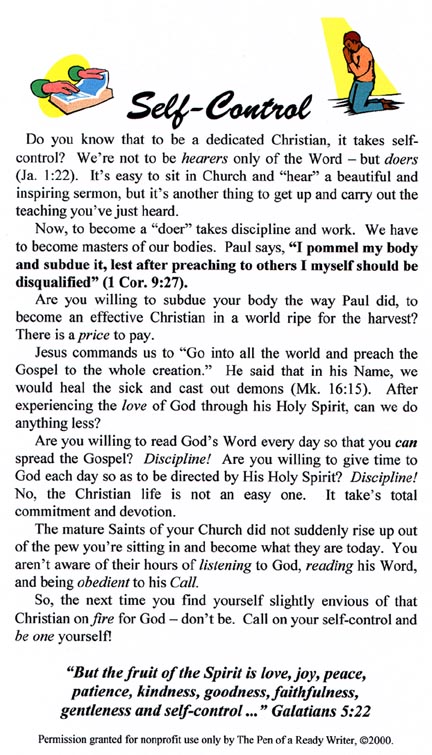
Spirit of Temperance


In order to do and live God's Will we must first reign in our own passions, this means controlling those elements within ourselves that draw us away from God and creates a chasm between His Divine Will and our own self will. It is important to not only practice self control over our carnal natures it also means controlling all aspects of our life that we have placed as obstacles towards our quest for holiness.

If our inner lives are out of control, this will exhibit itself in one's outward life, in that what comes out of a person's mouth is a good barometer to what lay in the heart. A sound heart that is centred on Christ speaks with due courtesy and good will towards others, they also caution those who have gone astray with good grace and gentleness. A person who lacks this Spirit of temperance is quick to anger and rash in their judgment of others, they also lack in all the other virtues, for every other virtue springs from self discipline.

A person that is out of control is also outside of God, for the Triune Spirit cannot live in a temptuous or extreme nature that is living for itself over and above everyone else. This does not mean that this state is permanent for if we realise our faulty nature we can once again restore a healthy relationship with God through the Sacrament of Penance which then allows God to fill our Hearts with His Grace.

In order to maintain this state of Grace, we must practice moderation in all our activities, in other words to live a life of deliberate discipline with full knowledge of our own inadequacies and failings. We all long to be happy but unless we practice temperance in all areas of our life then happiness will elude us, for holiness and egoism cannot exist side by side with one another, as St. Augustine says, "all persons want to be happy; and no persons are happy who do not have what they want." We can only be happy when we live to do God's Will, this means placing God at the centre of our lives and not on the periphery. For God gives us what we need and not always what we want, therefore to be truly happy is to want what God wants for us.

When we do anything in an excessive manner it is displeasing to God, even when it comes to prayer or mortifications. So if our motive is to impress others with our outward behaviour of feigned holiness no matter how many hours of prayer one undertakes all is loss if one looks for self gratification, and the applause of others. Once again as St. Augustine teaches us, "What is not loved in its own right is not loved." This tells us to love God for His sake and not for His Goods, and when we do love God for who He is, then we truly love the Beloved.

To practice self discipline in a healthy manner requires detachment from love of others and also a love for the luxuries of life, it is our neediness to be accepted and found lovable that is the driving force within our natures. But it is when we inordinately love that which is temporal over and above that which is Eternal that our vision of love becomes distorted and eventually dysfunctional. As St. Augustine said, "It is beyond doubt that the one cause of fear is either that we will lose what we love after attaining it or that, despite all our hopes, we will never attain it at all."

We need also to understand that detachment is not remaining aloof or displaying an attitude of coldness towards others. Some of our greatest Saints were passionate people but their love was directed totally towards God, this then allowed them freedom to love others as God does. For all love is but a spark from the Divine which ignites the hearts of those whom are consumed with an all encompassing love for God and for those whom God Loves. We attain this by recognising our own worthlessness and how much has been given to us by a loving God, in the words of St. Teresa of Avila, "We shall never learn to know ourselves except by endeavoring to know God; for, beholding His greatness, we realize our own littleness; His purity shows us our foulness; and by meditating upon His humility we find how very far we are from being humble."

Our lives cannot embrace this humility if it lacks self control in all area's in that if we lack in caring for our bodies, how then can we serve the Lord if we are serving ourselves? This is also true of our emotions, if we lack self control of our emotions, and take offense at the slightest remarks which then leads some to anger how then does this serve the Lord? If we allow our senses to be aroused by indecent subject matter, how then can any maintain a pure relationship with the Triune Spirit? Once again St. Teresa tells us, "Be gentle to all and stern with yourself."

If we truly long for a loving and healthy relationship with our Loving God we must practice self discipline in a spirit of temperance in all things. To acquire a spirit of detachment is also crucial to our spiritual well being, in that our focus is totally centred on our Creator and not the created. This degree of loving God for who He is will lead us to the peace and happiness that only Christ can give, St. Teresa knew this when she said, "Let nothing disturb thee; Let nothing dismay thee; All thing pass; God never changes Patience attains All that it strives for. He who has God finds he lacks nothing: God alone suffices."

In order to live a life of temperance we need to surround ourselves with all that is holy and pleasing to God, and disregard that which may create a stumbling block to our own spiritual growth.

In conclusion we reflect on the words by St Basil the Great, "The wise man must not boast of his wisdom, nor the strong man of his strength, nor the rich man of his riches." What then is the right kind of boasting? What is the source of man’s greatness? Scripture says: "The man who boasts must boast of this, that He knows and understands that I am the Lord. Here is man’s greatness, here is man’s glory and majesty: to know in truth what is great, to hold fast to it, and to seek glory from the Lord of glory. The Apostle tells us: The man who boasts must boast of the Lord. He has just said: Christ was appointed by God to be our wisdom, our righteousness, our sanctification, our redemption, so that, as it is written, a man who boasts must boast of the Lord."


Peace of Christ to ALL

Copyright © 2006 Marie Smith. All rights reserved.

Tuesday, February 14, 2006

False Peace False Spirit


Peace at any price is no peace at all, especially if the price for maintaining the peace is to live with a lie, rather than speak the Truth. To try and maintain a status quo of uneasiness between people in the hope that this will engender peace is to mistake real peace for a false peace, which in the end fails to achieve its purpose to make whole that which has been broken.

When a persons trust has been destroyed by another it takes time for the Divine Physician to heal a soul wound, for real peace lay not in the power of humans but is in the Hands of the Divine from whom we seek our own inner healing from wounds inflicted upon us.

Real peace does not mean an absence of anger, true and sincere peace of heart is maintaining a quiet peaceful heart amidst the raging turmoil of anger, hate and strife. It is the ability not to be swayed this way or that way or allowing others to provoke us or to allow others to manipulate us. This does not mean we must sit quietly and watch wrongs being said or done against another, but it is to speak the truth gently and firmly as it is and to then move on irrespective of how others accept the truth spoken.

In order to maintain this peace we need to be Christ centred and to keep a strong prayer life which is the life blood of the soul. This takes discipline and also wisdom to discern what is truth and to then speak this truth with conviction whilst keeping a gentle heart.

The world at times can be a tumultuous place, where family and friends can become embroiled in open disputes. Where nations can rise against another and where leaders in an attempt to maintain a false peace endeavour to make pacts with the Devil. It is good to strive to bring peace to our world but not at the price of our freedoms which those who live in civilized countries enjoy. History records the attempts made before the Second World War, when the then Prime Minister of Britain Neville Chamberlain met the German Chancellor Adolf Hitler and though both signed the Munich Peace Agreement, still peace did not eventuate even though upon his return to England Prime Minister Chamberlain made this statement, "My good friends, for the second time in our history, a British Prime Minister has returned from Germany bringing peace with honor. I believe it is peace for our time... Go home and get a nice quiet sleep." Unfortunately it would be many years before Europe would be able to enjoy a 'quiet sleep'.

We cannot maintain our peace by putting our heads in the sand and pretending that all is well or by negotiating with those who use and abuse our good intentions for their own manipulative purposes. This is not to say that we must be at war with everyone but it does mean we must become wise to the motives of others and not allow ourselves to be moved from the centre of God's Heart. St. Francis of Assisi teaches us in these words, "while you are proclaiming peace with your lips, be careful to have it even more fully in your heart." This wise Saint knew that in order for us to keep our peace we must live it from within, for a heart that is easily roused to anger is a heart not living in inner tranquility.

To live a peaceful life in this world of turmoil and strife, we need to understand that our enemy is not any one person the enemy is within our own soul, but at times the Principality of evil will use people to drive a wedge of discontent amongst Gods beloved children. This is why it is essential to keep a strong prayer life and to make use of the Sacraments of the Church as often as possible. A person that is centred on Christ is not easily moved by the emotionalism of others or by those who prefer to embrace hate rather than love. As that great Doctor of the Church, St. Francis de Sales said, "Do not lose your inward peace for anything whatsoever, even if your whole world seems upset." This is a learning process in that we at times all lose our temper and can become agitated over the actions of others, but this is not an excuse to remain in that condition.

This is why it is wisdom to remove ourselves from the company of those who have embraced hatred and vitriol and who refuse to listen to anyone including the Word of God as Scripture reveals, "Everyone who commits sin commits lawlessness, for sin is lawlessness. You know that he was revealed to take away sins, and in him there is no sin. No one who remains in him sins; no one who sins has seen him or known him. Children, let no one deceive you. The person who acts in righteousness is righteous, just as he is righteous. Whoever sins belongs to the devil, because the devil has sinned from the beginning. Indeed, the Son of God was revealed to destroy the works of the devil. No one who is begotten by God commits sin, because God's seed remains in him; he cannot sin because he is begotten by God. In this way, the children of God and the children of the devil are made plain; no one who fails to act in righteousness belongs to God, nor anyone who does not love his brother." This is a warning to each of us, for the company we keep we will become, therefore to those who refuse to follow and obey the Word of God and the Teachings of our Church should be let alone as others pray that they will once again return to Gods embrace.

It is when we embrace people who are in obvious states of sin and who refuse to follow the Tenets of our Church that we can become confused in our unwillingness to judge others. We do not judge those we caution if their behaviour is sinning against God and their fellow brothers and sisters in Christ. Through fear of being thought judgmental we then become enablers to the sins of another as we encourage the very actions which may lead to their doom and become accomplices to vice!

In order to keep our peace we need to recognise that this peace is from Christ and cannot be found anywhere else. It is Gods Gift to those who have put aside their 'old selves' and embraced the 'new self' as they walk with Christ in the Light of His Word and the Teachings of His Church.

Our obligation as God fearing Christians is to speak God's Truth with gentleness and then to stand firm if any find this Truth to be loathsome. It is not up to us to engage in bickering but instead to speak it and then to quietly pray for those who find this Teaching too hard to accept.


To remain quiet in the midst of sin as if it were not happening is not 'peace', that is false peace which leads to false charity when we condone evil as a right. It is never right to do wrong as if the end justifies the means, we must at all times speak The Truth even to our own peril as Winston Churchill once said, "Truth is incontrovertible, malice may attack it and ignorance may deride it, but, in the end, there it is."

We must at all times remember that we are in the company of our Lord and what cannot be spoken in His Presense should not be whispered in dark corners, as St. Teresa of Avila said, "however quietly we speak, God is so near he will hear us."

Peace of Christ to ALL

Copyright © 2006 Marie Smith. All rights reserved.

Monday, February 06, 2006

Spirit of Patience


We live in an age of rage, if a car takes too long at a stop sign, our frustrations tend to grow until within the space of 5 minutes it has turned into rage. When someone pushes in front of us at a shopping centre queue our impatience soon turns into rage. So we have car rage, trolley rage, car park rage, smoking rage, sports rage etc. So much rage so little patience!

In a time where everything has been made easy, we no longer have to walk anywhere, we no longer have to suffer in the cold or heat as our heaters and Air conditioners make living comfortable. Meals can be served up in minutes and on some days Mother or Fathers don't have to cook at all as many families head for the fast food restaurants. We have everything at our convenience, yet many are also so easily provoked, that a small wait can soon turn into irrational rage.

But the real problem begins when we lose patience with our spouses and with our children, if we treat each other like nuisances, then we lose the entire focus of why we are here and it is not to make our own life easy but to give to others as Jesus would have us do. It also means putting in the hard work in our relationships rather than the quick cut and run because it is all too difficult, this calls for unselfishness and self sacrifice, for what we give to others will be returned to us ten fold.

Therefore if we make members of our family feel as if they are a vexation to us, we must then ask who we have placed as a priority, our families or ourselves.

The message that society projects out to the susceptible is that the family unit is redundant and that women need to be emancipated from their 'chained marriages’ as if a Holy Sacrament is a business deal! As the late Pope John Paul II said, "Motherhood is sometimes presented as something backward or as a limitation of a woman's freedom, thus distorting its true nature and dignity. Children are presented not as what they are-a great gift of God- but rather as something to be defended against."

In order to gain patience we need to understand that we too are taxing someone else's patience, none of us are perfect and we all have our faults and foibles, does this mean that none of us are deserving of love, because no one is patient enough to accept our differences? Human beings must not become disposable because it takes too much effort to love them just as they are where they are.

This lack of patience with each other is one of the deciding features of many divorces, very few people are now ready to put in the heavy work nor do they wish to be patient while situations resolve itself. And at times we will feel hurt, anger, frustration at events and people who disappoint us, but the answer is not in running away, it lay in maintaining patience, in an attitude of long suffering as we allow the healing process time to work over a period of time.

And at times our Loving God will allow difficult situations to arise in order to strengthen that which is weakest in our natures but also to help us become more reliant on our Heavenly Father to give us the Graces needed to grow in holiness. For unlike us God see's things in an eternal frame whereas our own eye perceives only the present time.

Longsuffering patience teaches us tenacity and perseverance to help us run the good race, it also teaches us to trust in a Loving God to guide us through painful minefields and to have confidence that God will not abandon us but will instead walk beside us as we overcome through Grace the difficulties and pain that we suffer through.

For it is in evolving through painful issues ! that builds character, so that we become stronger and grow more in patience when we realise that all we have is Gift, it was never ours to selfishly clutch or horde away. When one of the great Master painters finished a work did the artist hide his painting in secret cupboards so that only he may view it? Or did he paint to give joy to all who would appreciate the work involved and admire the beauty which the artist was able to capture.

Patience entails waiting, all through the Old Testament are Books which focus on long waits as God accomplished things in His time and not ours. The Jewish people wandered through the desert for 40 years that would seem to long for many of us as it did to the Jews of that day, yet to God it is but a blink of an eye.

Learning patience is to walk up the staircase of holiness one step at a time, for as St. Augustine said, "Patience is the companion of wisdom." Those who rush headlong into life with no thought to any but themselves will find, in the end they will have failed to enjoy the journey.

Peace of Christ to ALL

Copyright © 2006 Marie Smith. All rights reserved.

Thursday, February 02, 2006

Spirit of Goodness


Goodness does not come naturally to many of us, it has to be learnt, and once learnt it must then be practiced or else it becomes wasted words in a world full of meaningless prattle. But how exactly do we acquire this goodness, for we know that God is Good, but we are not God.

One of the first steps is to become acquainted with God Himself through study of Scripture in line with the Church's Teachings where we learn what is pleasing to God and what is not! Another step is to learn from our Saints, who suffered some even unto martyrdom, yet they loved till the end, for their hearts were full of good will towards all men. As St Camillus de Lellis said, "think well. Speak well. Do well. These three things, through the mercy of God, will make a man go to Heaven."

The third step is discipline; we cannot become good if our hearts are still held captive by the tyranny of memory of wrongs done against us, which then embitters the heart which will poison all efforts of trying to be good. This is where disciplining ones mind against recalling past hurts is integral to future growth as we learn and embrace goodness.

But it is also not enough to learn it, we must then live it, and we can only do this when we come to the realisation of our own iniquities and our own failings towards God. Once we learn these hard truths about ourselves comes the longing to be better and to do good, not in order to gain things for ourselves but to give from the goodness that has been granted us from a Loving God.

With these steps taken we must then choose to do good, for like kindness, goodness is also a choice. We must not wait to feel good in order to do good, we instead must do good irrespective of our feelings. For at the heart of goodness is Godliness, in that we are not the source of goodness, as Scripture says, "Just so, every good tree bears good fruit, and a rotten tree bears bad fruit. A good tree cannot bear bad fruit, nor can a rotten tree bear good fruit. Every tree that does not bear good fruit will be cut down and thrown into the fire. So by their fruits you will know them."

But goodness takes practice, for at times our patience will be tested and our failings will rise up as obstacles, but this should not deter the soul who seeks to do good for love of God and of their fellow man. So in order to fulfil God's Will which is to bear good will towards all men, in full humility of what we ourselves have received from the Triune Spirit we need to learn and become obedient to what The Word instructs, as St. Benedict said, "the first step of humility is unhesitating obedience, which comes naturally to those who cherish Christ above all."

The biggest obstacle we face when embracing a spirit of goodness is to think we are its source and therefore we expect thanks for any good we do and become aggrieved when the that thankyou is not forthcoming. When our Lord healed the ten lepers how many came back to thank Him? Did that stop our Lord from doing further good? No! Because Jesus did not do good to gain accolades for Himself, He did good because He IS Good. That is not to say that Jesus did not feel hurt or disappointed of course He did, but He did not allow that to affect Him.

So too we must follow the example which Jesus Himself gives us in the Gospels as Scripture teaches us, "A good person out of the store of goodness in his heart produces good, but an evil person out of a store of evil produces evil; for from the fullness of the heart the mouth speaks. "Why do you call me, 'Lord, Lord,' but not do what I command?" And St Augustine instructs us, "tell us straight that you do not believe in the Gospel of Christ; for you believe what you want in the Gospel and disbelieve what you want. You believe in yourself rather than in the Gospel."

For if we put conditions on who we choose to be good too, then what does that say about the person and their sincerity or lack thereof?

We expect Jesus to be good to us, yet we fail to follow His example when our goodness is conditioned, for what would become of all of us if Jesus also placed conditions on our level of 'goodness'.

To finish in the words of Mother Theresa, "The good you do today, will often be forgotten. Do good anyway. Give the best you have, and it will never be enough. Give your best anyway. In the final analysis, it is between you and God. It was never between you and them anyway."

Peace of Christ to ALL

Copyright © 2006 Marie Smith. All rights reserved.